Image
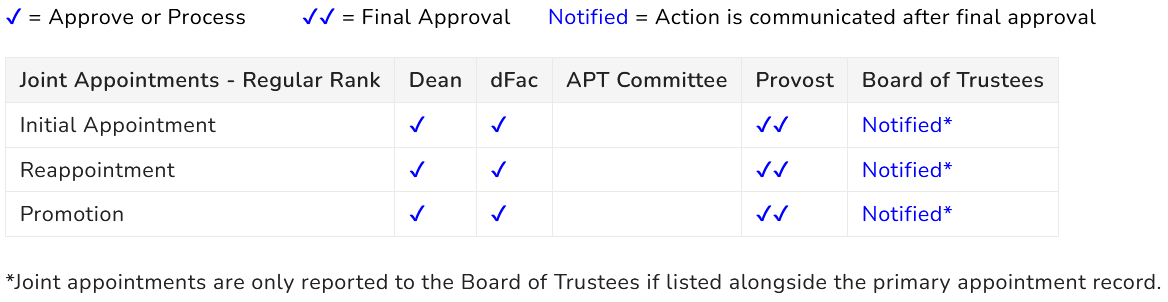
The administrative distinction between secondary and joint appointments is that secondary appointments do not involve any contribution to the faculty salary line; joint appointments do. This matter must be worked out between the Chair and the Dean (for inter-school appointments, between the Deans and the Provost) prior to considering a joint appointment. However, even when a unit does not make a financial contribution, it may identify some appointments as joint in order to grant voting rights faculty on special issues (e.g., bylaws and personnel matters). The agreement governing the joint appointment should clearly identify any such privileges. Joint faculty appointed to ad hoc personnel review committees may vote with other committee members on the committee’s report, even if they are not entitled by the unit's bylaws to vote in the subsequent general faculty meeting where the report is considered and voted on.
Academic units wishing to offer a joint appointment to a current regular-rank faculty member holding a primary appointment in another unit at Duke must obtain the permission of the Provost. The unit reviews the credentials of the candidate, votes on the request in a meeting of the appropriate faculty, and sends a written request to the Dean who, in turn, forwards it to the Provost for a decision. Upon approval by the Provost, the Dean writes a contract letter to the faculty member consistent with the terms of the request. This letter must be signed by the faculty member, returned to the Dean and then reviewed and approved by the Provost. Academic units wishing to offer a joint appointment to a regular-rank faculty member being recruited to Duke should consult procedures for joint searches.
In both cases – offer to a current faculty member or to a potential faculty member – the unit's request to the Dean (and the Dean’s to the Provost) should state its reasons for requesting the appointment, the candidate's current primary title and term, the rank at which the appointment will be made, and the length of term requested. The requesting department must send the Dean a copy of the agreement based on the templates found in Appendix B covering faculty responsibilities and privileges concluded between the Chairs of the two units. The Dean attaches this agreement to the request sent to the Provost. It is the responsibility of the two units to address all the pertinent questions identified in the sample agreement and any others they deem necessary. Issues not addressed in the agreement will be governed by the rules of the primary unit.
In dFac, joint appointments are coded as "J".
dFac Users: View the documentation required to finalize each action.
screen-reader friendly version of approvals chart